Knowledge Centre
How to Reconstitute Peptides
Freeze-dried to ready-to-measure, step by step.
Research peptides arrive as a freeze-dried powder. Reconstitution is the simple process of dissolving that powder in bacteriostatic water so it can be measured accurately. Here is the complete beginner walkthrough.
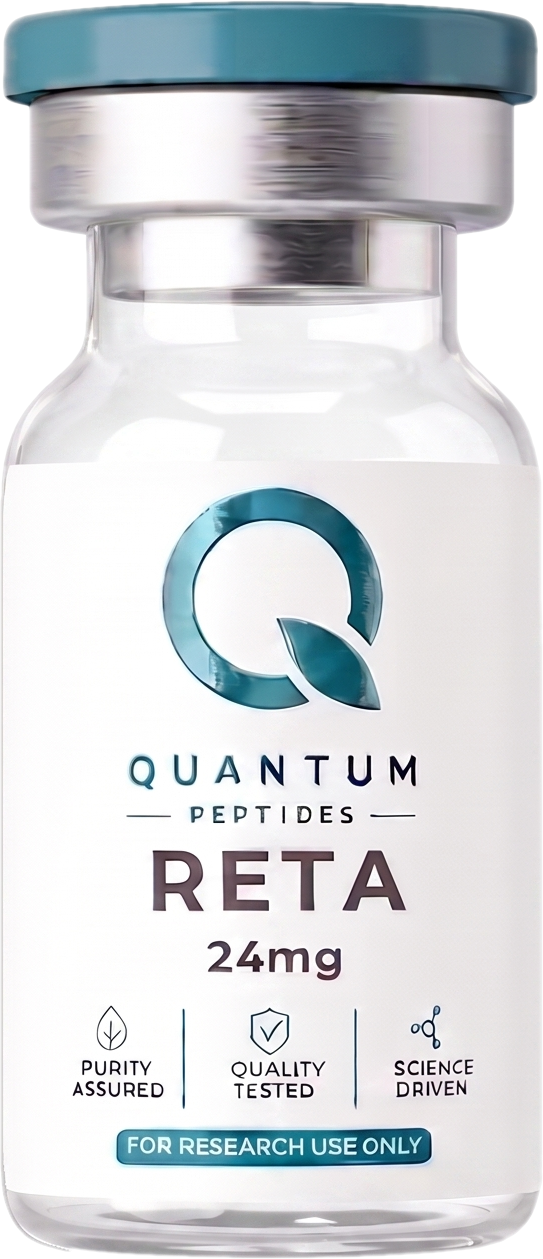
Research peptides ship in lyophilised (freeze-dried) form because the dry powder is far more stable than a solution. In powder form, stored cold, a peptide can remain stable for roughly two years refrigerated and up to three years frozen. Once it is dissolved, that window shrinks to about 30–45 days in the fridge.
That is the whole reason for reconstitution: the compound is stable as a solid, but it can only be measured and dispensed as a liquid. Keep powdered vials cold, away from light and heat, and only reconstitute what you plan to use within the next few weeks.
- Your lyophilised peptide vial
- Bacteriostatic water (0.9% benzyl alcohol)
- Alcohol swabs
- A 3 mL syringe with a Luer-lock tip
- A 25G or 27G needle (a thinner, higher-gauge needle protects the rubber stopper)
- A sharps container (optional but recommended)
- Uncap both vials. Remove the flip caps from the peptide vial and the bacteriostatic-water vial.
- Sanitise the stoppers. Wipe both rubber stoppers with an alcohol swab and let them air-dry for a couple of minutes.
- Attach the needle to the 3 mL syringe by twisting it onto the Luer-lock tip.
- Draw your bac water. Pull back the plunger to the volume you want. Overfilled? Push the excess back until you hit the mark.
- Insert at a slight angle into the peptide vial to avoid pressure build-up.
- Release the water gently down the inside wall of the vial — never blast it directly onto the powder. If the plunger starts moving on its own, hold it back so you stay in control.
- Swirl to dissolve. Gently swirl, roll, and invert the vial for two to five minutes. The water needs to pass through the powder repeatedly. Do not shake.
- Check clarity. The solution should be perfectly clear with no floating particles. Cloudy or clumpy? Wait a minute and keep swirling.
- Cap, dispose, and store. Cap the needle, discard it safely, and return the vial to the fridge between uses.
There is no single correct volume — the amount of bac water simply sets how concentrated your solution is. A practical default for a standard small vial is 2 mL, with anywhere from 1 mL to 3 mL being acceptable. More water makes very small (micro) measurements easier to draw, but because insulin syringes typically max out around 1 mL, using a large volume can force you into multiple draws to reach a single target amount.
The simple dosing formula
- Bac water (mL) ÷ total peptide (mg) = mL per 1 mg.
- Example: a 5 mg vial with 2 mL of water → 2 ÷ 5 = 0.4 mL per 1 mg.
- Scale from there: 1 mg = 0.4 mL, 2 mg = 0.8 mL, 0.5 mg = 0.2 mL.
Prefer not to do the maths by hand? Our Dosage Calculator converts vial size, water volume, and target amount into an exact draw for you.
Why bacteriostatic water instead of plain sterile water?
Bacteriostatic water contains 0.9% benzyl alcohol, which suppresses bacterial growth and gives the reconstituted vial a usable shelf life of around 30 days. Plain sterile water has no preservative and would need to be used almost immediately.
Can I use saline (sodium chloride) instead?
For most peptides, saline works. The key exception is Retatrutide, which should only be mixed with plain bacteriostatic water — sodium chloride causes it to precipitate (clump and fall out of solution) and ruins the vial. Plain bacteriostatic water is the safe default for everything.
Can I freeze a reconstituted vial?
No. Freezing a dissolved peptide can damage its structure. Keep reconstituted vials refrigerated at 2–8°C and avoid repeated freeze–thaw cycles. Long-term storage should be done in powder form.
I accidentally shook the vial — is it ruined?
Not necessarily. Let it settle, then inspect it. If the solution is clear, it is generally fine; if it turns cloudy or clumpy, discard it.
The powder will not fully dissolve. What now?
Warm the vial gently in your palm and swirl again for a few minutes, moving the water from top to bottom through the powder. Persistent particles are extremely rare.