04
◆ The Meaty One
Reconstitution, injection & storage.
How peptides are handled plays a major role in both safety and effectiveness. This section covers reconstitution, injection technique, storage, and managing common injection-site reactions — so you get consistent results, less discomfort, and predictable outcomes over time.
Before starting anything, watch this
How to correctly prepare and inject your peptides
💧 Powder to protocol in 8 steps
Lyophilized (freeze-dried) peptide powder is brought to life with bacteriostatic water.
🧰 Your reconstitution kit
Five things on the bench before you start.
Lay it all out first — clean, calm, no scrambling mid-mix.
🧪Peptide vialThe freeze-dried powder
💧Bacteriostatic waterThe solvent
💉Recon syringe3ml · 18–23 gauge
🧻Alcohol wipesSanitize stoppers
📊Dosage chartKnow your volume
🧮Or skip the mathTry our calculator →
1Clean hands
Wash thoroughly and work on a sanitized surface.
2Remove caps
Take the plastic caps off both vials.
3Sanitize stoppers
Wipe each rubber stopper with an alcohol swab.
4Draw BAC water
Measure per your reconstitution chart.
5Inject down the side
Aim the stream at the glass, slowly — not onto the powder.
6Equalize pressure
Add or remove air so the vacuum is balanced before withdrawing.
7Swirl, don't shake
Gently roll until fully dissolved.
8Refrigerate
Store the reconstituted vial in the fridge.
①Swirl, never shake.
Shaking shears and degrades fragile peptide bonds.
②Equalize pressure.
Balance the vacuum by adding or taking air out of the vial.
💉 Injection guide
Most peptides are given subcutaneously — into the fatty tissue just beneath the skin. Certain peptides, such as BPC-157 or TB-500, may be injected closer to an injury site if advised by a provider.
Preparing for injection
1Wash your hands and clean the injection area.
2Gather your reconstituted peptide, injection syringe, alcohol wipes, and dosing instructions.
3Confirm your dose in units before drawing.
How to inject
1Clean the site with an alcohol wipe and let it dry completely.
2Pinch a small fold of skin.
3Insert the needle at a slight angle into the subcutaneous tissue.
4Inject slowly and steadily.
5Remove the needle and dispose of it safely in a sharps container.
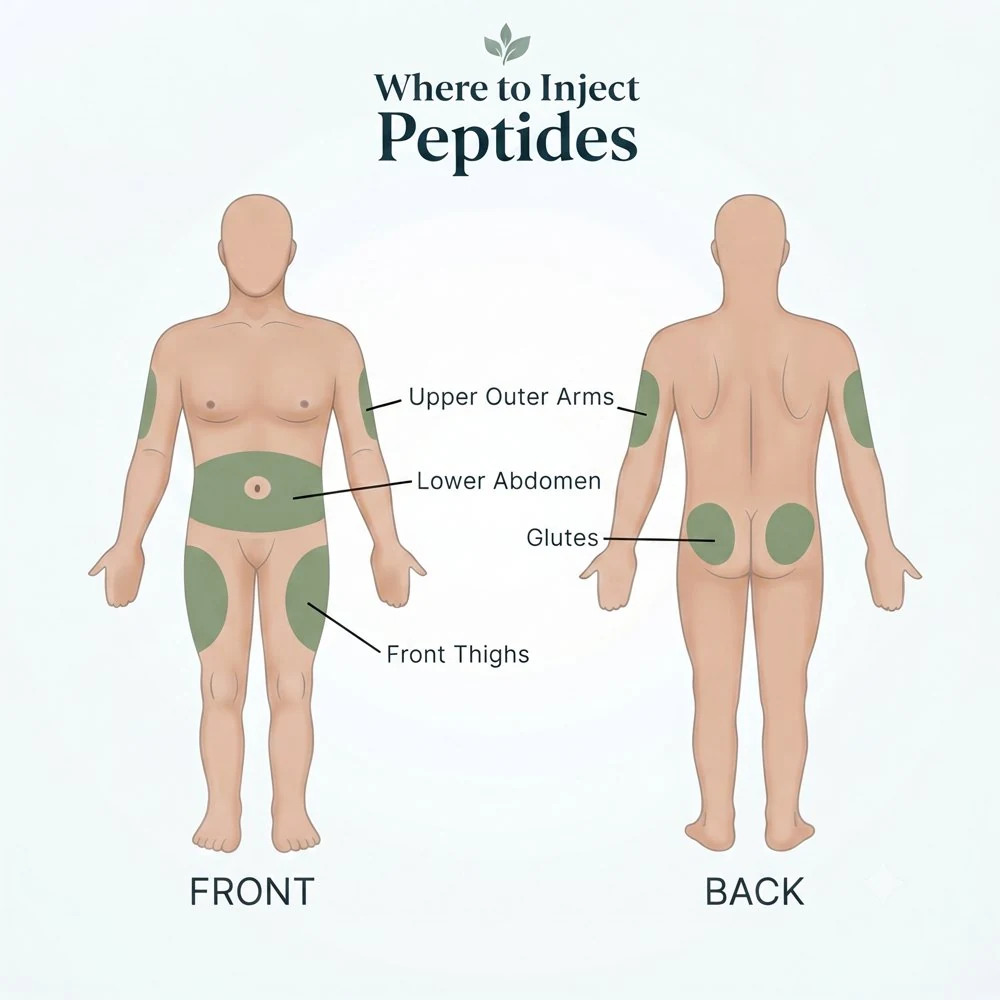
Where to inject — rotate between sites
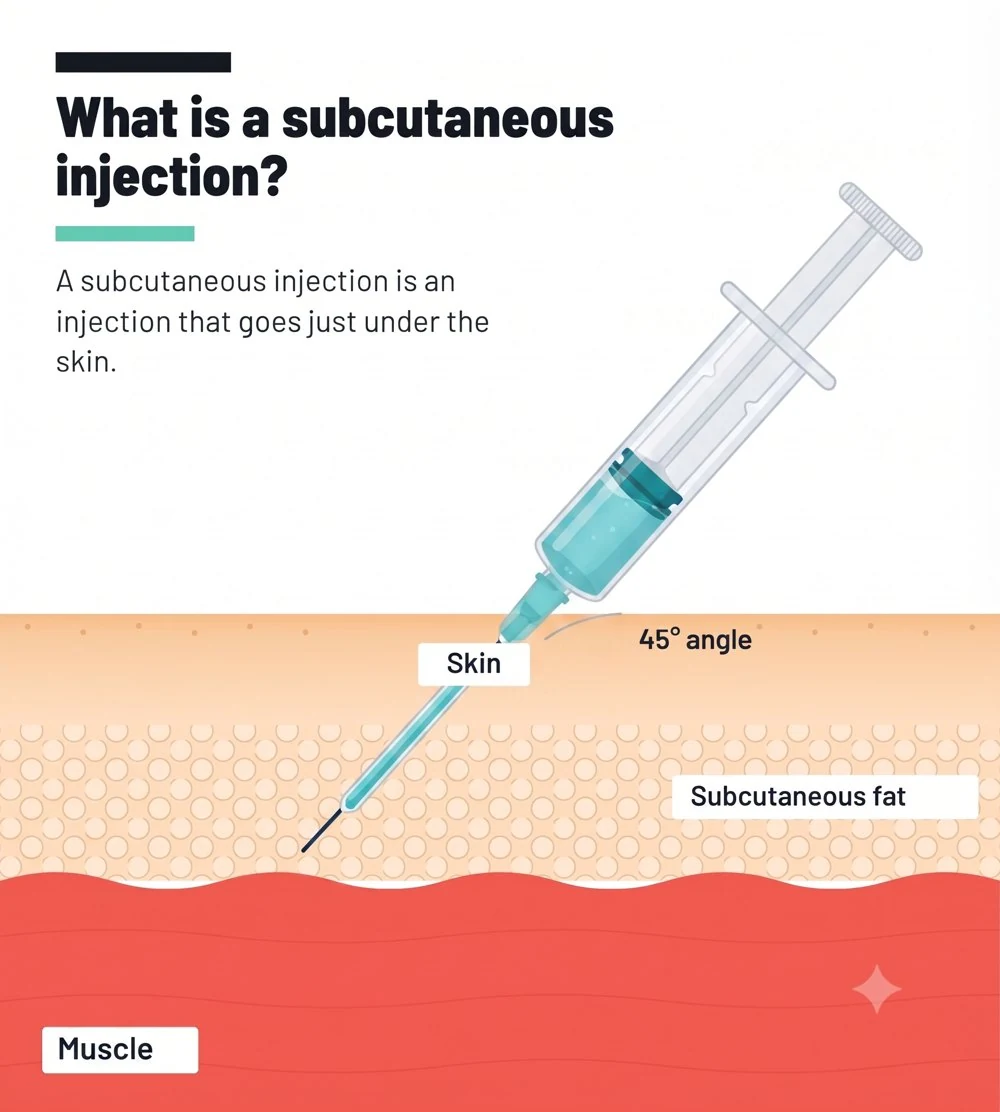
Subcutaneous — just under the skin
▶ Watch · Using an injection pen
🖊️ Injection pen basics
Loading a reconstituted peptide into a refillable pen — each step flips open as you scroll.
1Remove air from cartridge.
1
2While leaving the needle in the top of the cartridge, push the stopper up (with something like a pen).
2
3Inject the reconstituted peptide from the vial into the cartridge, watching that the stopper at the bottom doesn't push off.
3
4Remove excess air out of the cartridge by leaving the needle in the top and pushing the stopper up again.
4
5Load the cartridge into the injection pen.
5
6Screw the needle tip on.
6
7Twist and press the dose clicker to move the plunger up until it's seated at the bottom of the cartridge stopper.
7
8Prime by turning the dose button to 1–2 units and pushing the button. Repeat until you see a little bubble of peptide liquid come out of the needle tip.
8
⚠️Always remove the air from the cartridge first. Trapped pressure can push the stopper out — and you'll lose the peptide.
🌡️Tip — When you take peptide out of the fridge to administer, let it sit at room temperature for ~5 minutes to come to temp.
💧Tip — Make sure the alcohol-swabbed injection site is completely dry before injecting (about 15 seconds).
🧬 Combining peptides in one injection
Some peptides can be safely combined into a single syringe to reduce the number of injections, improving comfort and consistency when done correctly.
How to combine
- Balance pressure in each vial before drawing.
- Draw each peptide sequentially into the same syringe.
- Inject within a few minutes of combining.
- Avoid preloading syringes for later use.
- Confirm the solution stays clear and free of cloudiness.
⚠️ Mix safely
- Only combine compatible peptides — when unsure, inject separately.
- Inject within a few minutes; never preload syringes for later.
- The blend must stay clear — discard if it turns cloudy.
Some peptides lose effectiveness or increase irritation when mixed. If there's any uncertainty, inject them separately or consult a provider.
Which of yours can combine?
Our Personal Roadmap includes a custom mixing & compatibility check — we'll tell you which of your stack can share one syringe.
Build Your Stack →
🩹 Injection-site reactions
Mild redness, itching, swelling, or small hives at the site are relatively common and usually not a true allergy — better site rotation and cleaner prep usually settle it down.
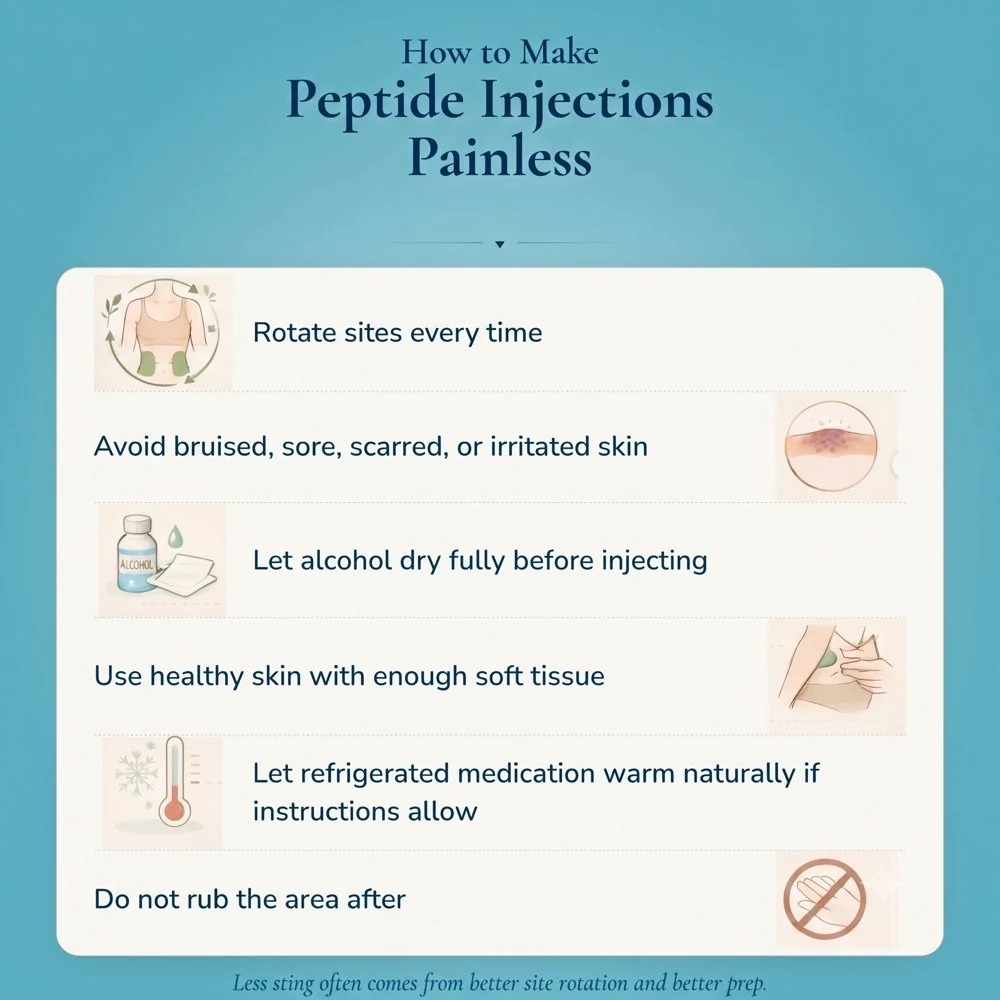
How to make peptide injections painless
❄️ Storage — keep it cold, keep it potent
| Form | Where | Shelf life |
|---|
| Powder (lyophilized) | Fridge | ~6 months |
| Powder (lyophilized) | Freezer | Up to 2 years |
| Reconstituted | Refrigerate | ~28 days |
The 28-Day Rule
Reconstituted peptide is generally considered most optimal for about 28 days after it's mixed with water. Track your date and plan your vials around it.