Knowledge Centre
How to Read a Peptide COA
Certificate of Analysis, decoded.
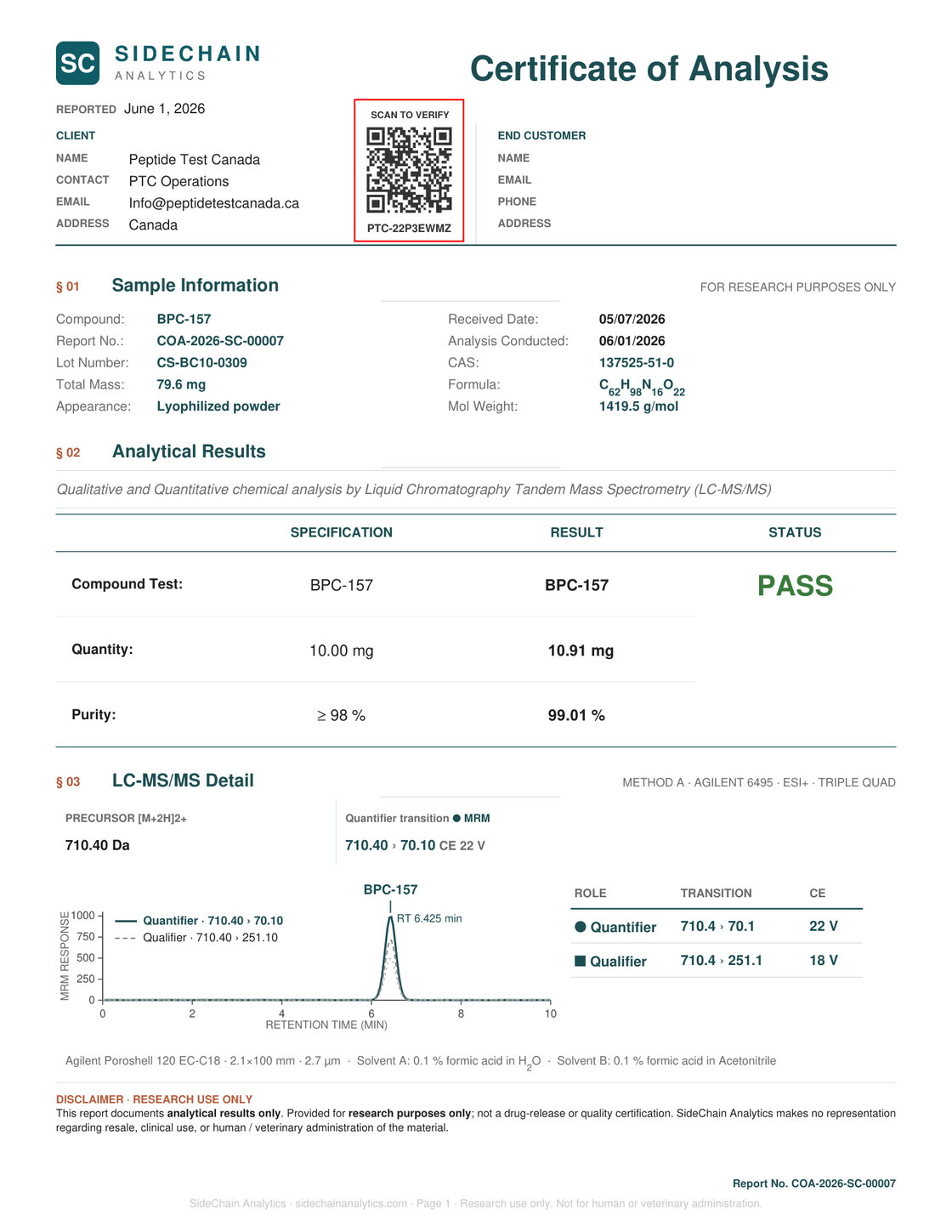
A Certificate of Analysis (COA) is the lab document that proves what is actually in a vial. This guide walks through a real COA issued through Peptide Test Canada and explains every section — so you can confirm identity, purity, and authenticity before you buy.
Jump to a section
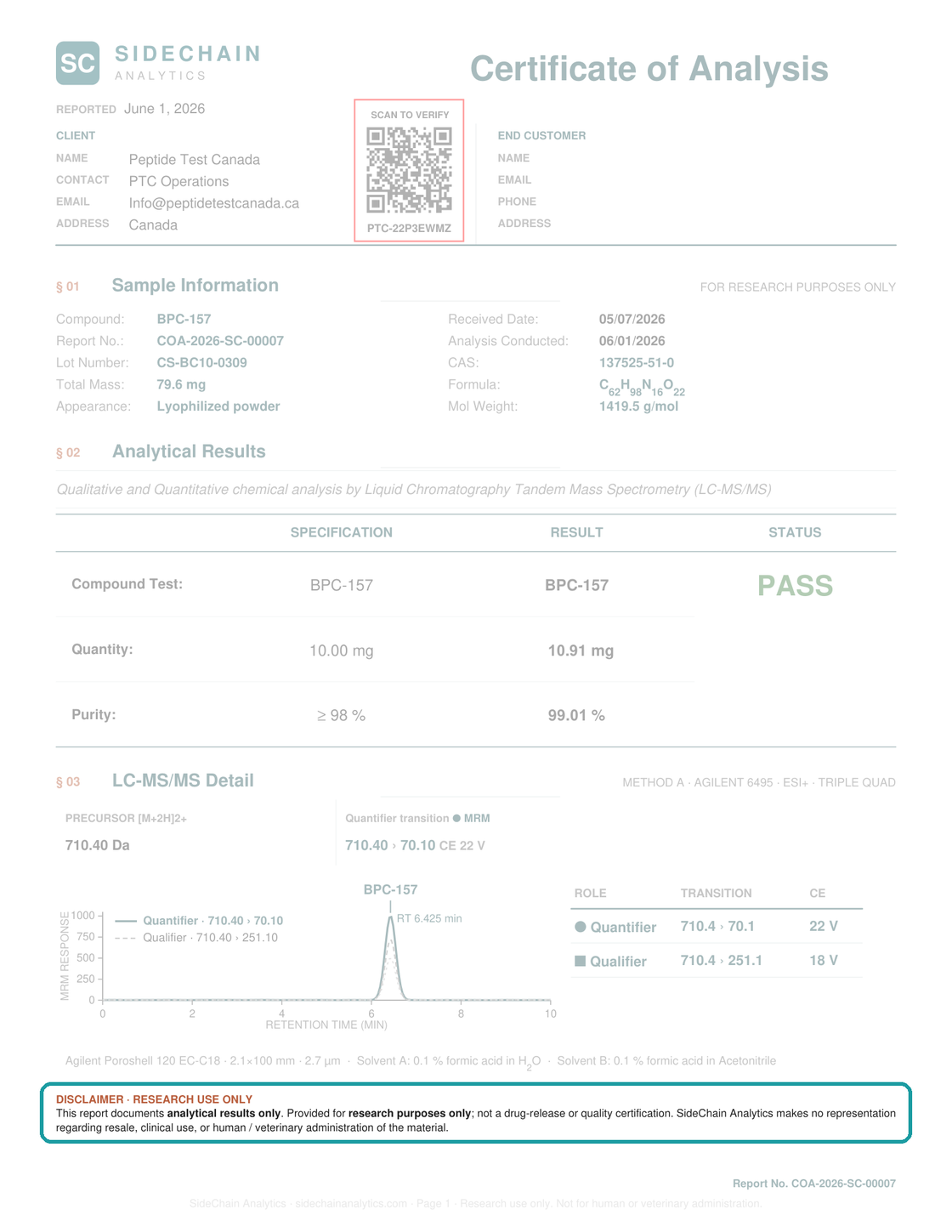
The top of every COA tells you who produced it and how to reference it. Look for the testing laboratory's name and logo, the unique report number, the reported date, and the client the sample was tested for. On this example, the report number is COA-2026-SC-00007, it was reported on June 1, 2026, and it was tested for Peptide Test Canada.
The report number is your anchor — note it down, because you'll use it (together with the verification code) to confirm the certificate is genuine and matches your batch.
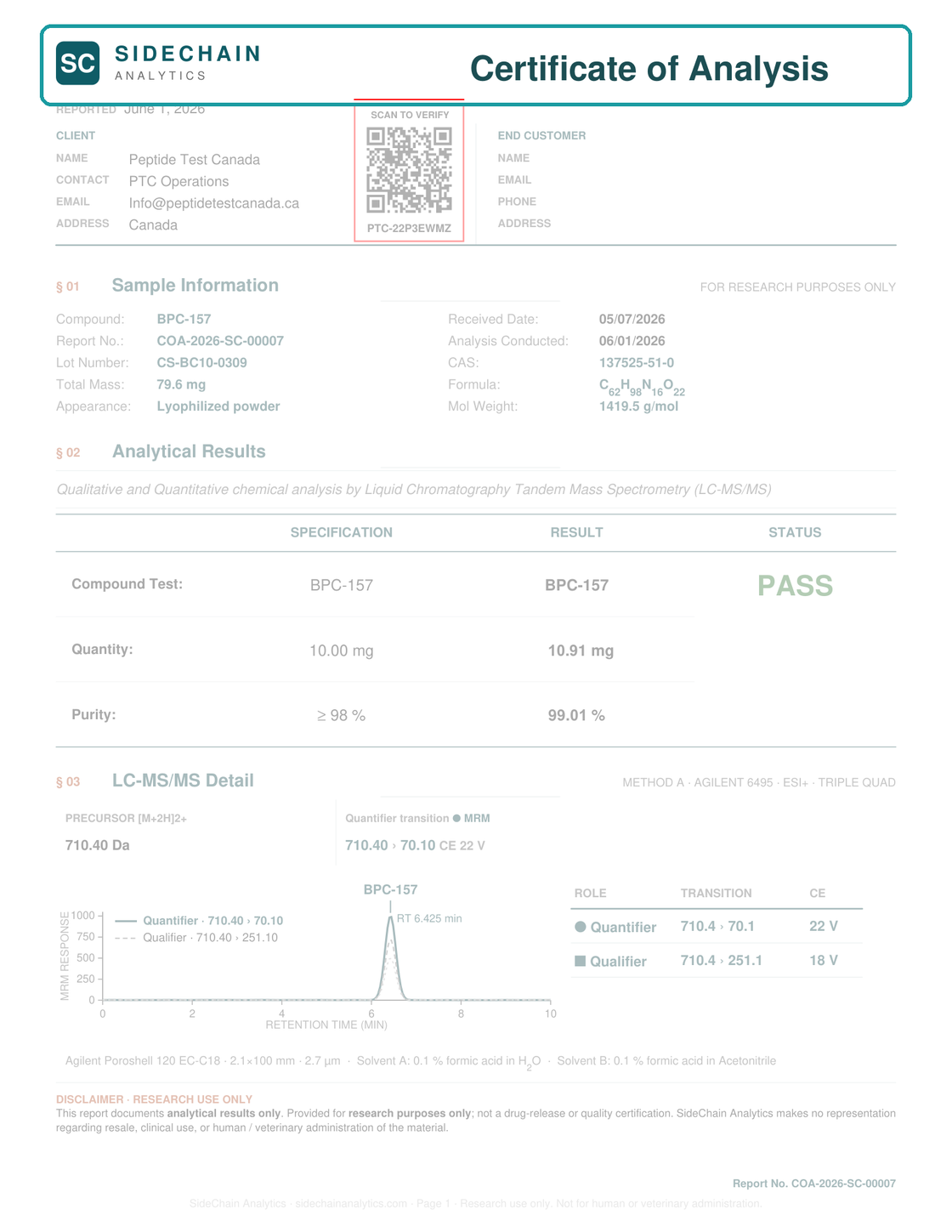
A genuine COA can be checked independently. The Scan to Verify panel holds a QR code and a unique verification code — here, PTC-22P3EWMZ. Scanning the QR code or entering that code with Peptide Test Canada confirms the certificate is authentic and that its results match the batch, rather than being a PDF that was edited or fabricated.
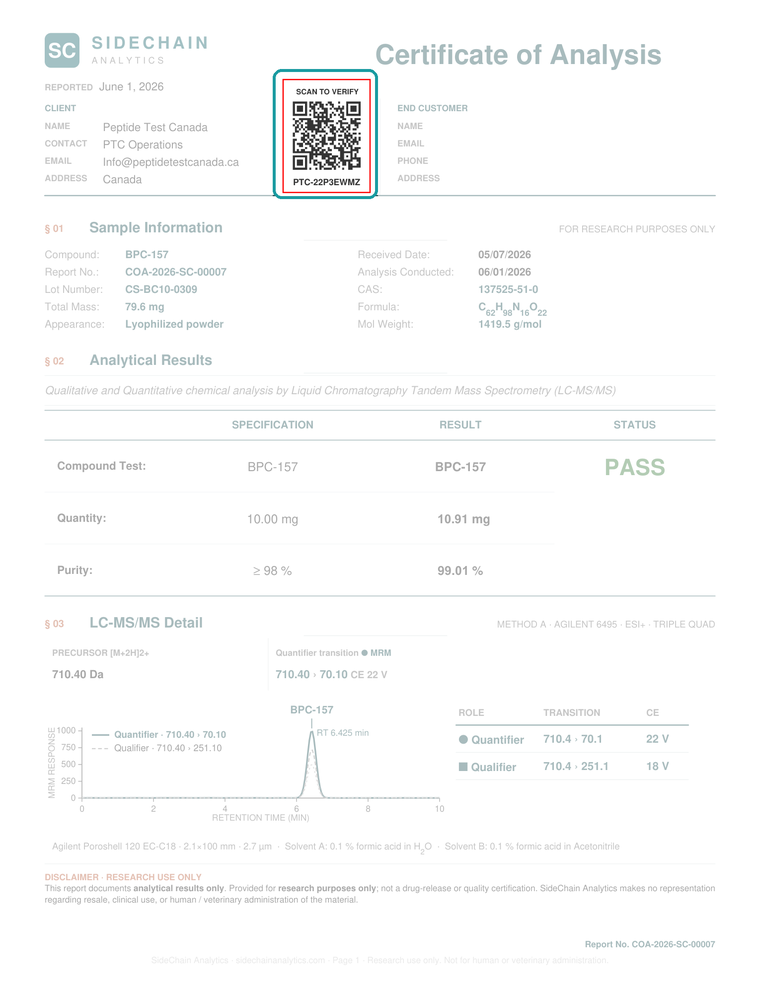
This block identifies exactly what was tested. The fields that matter most are:
- Compound (BPC-157) — must match the product you're buying.
- CAS number (137525-51-0) and molecular formula (C₆₂H₉₈N₁₆O₂₂) — the chemical fingerprint of the molecule.
- Lot / batch number (CS-BC10-0309) — links these results to your specific vial.
- Molecular weight (1419.5 g/mol), appearance, total mass, and the received / analysis dates.
Cross-check the compound name, CAS number and formula against the product listing. Any mismatch between the COA and the peptide you ordered is a red flag.
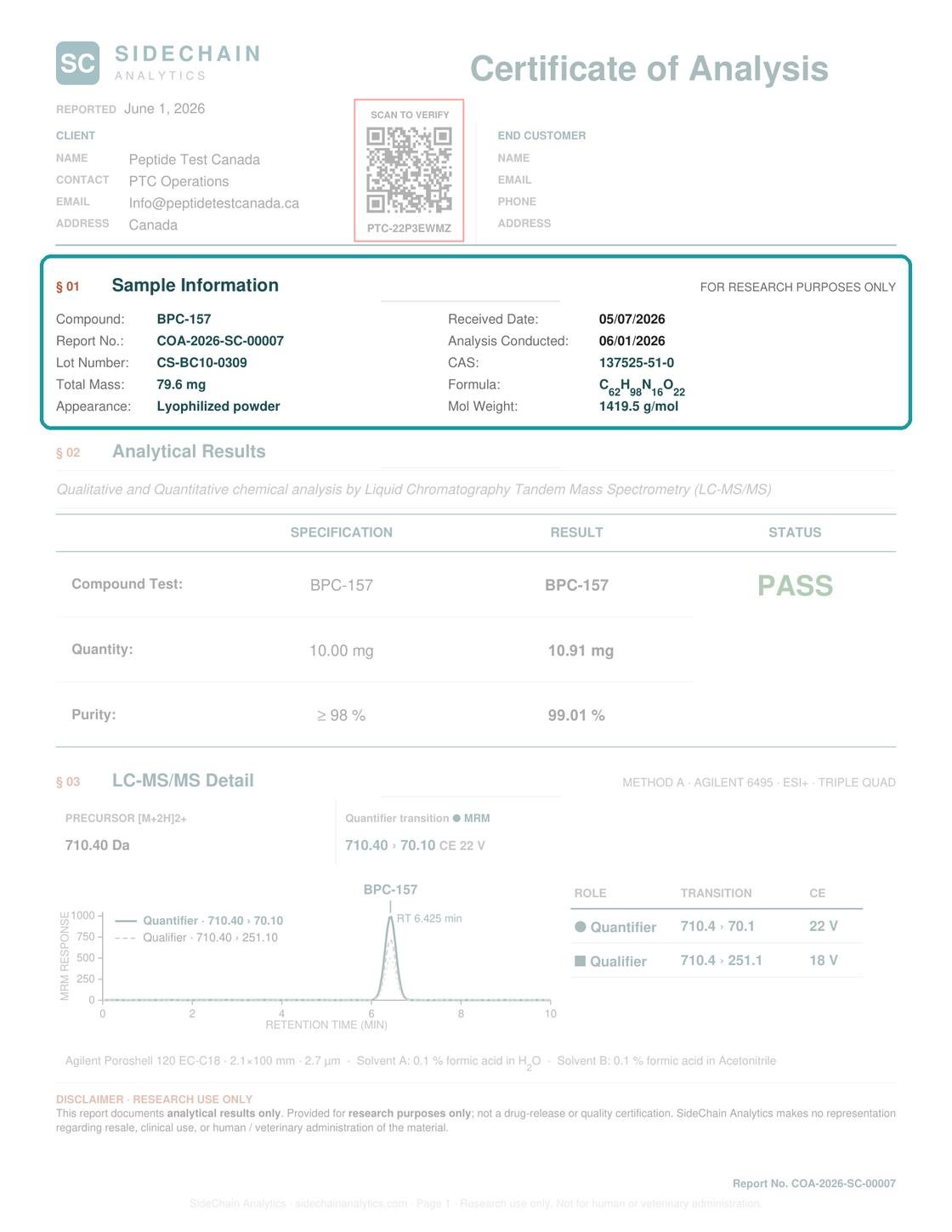
This is the heart of the COA — it compares the specification against the actual result and gives an overall status. There are three rows to read:
- Compound Test — confirms identity. Result: BPC-157, status PASS.
- Quantity — label claim (10.00 mg) versus the measured amount (10.91 mg).
- Purity — specification (≥ 98%) versus the measured result (99.01%).
Purity is calculated from the area of the main peptide peak compared with all peaks in the sample. Research-grade peptides should read 98% or higher, with premium material at 99%+. A clear PASS means the batch met every specification.
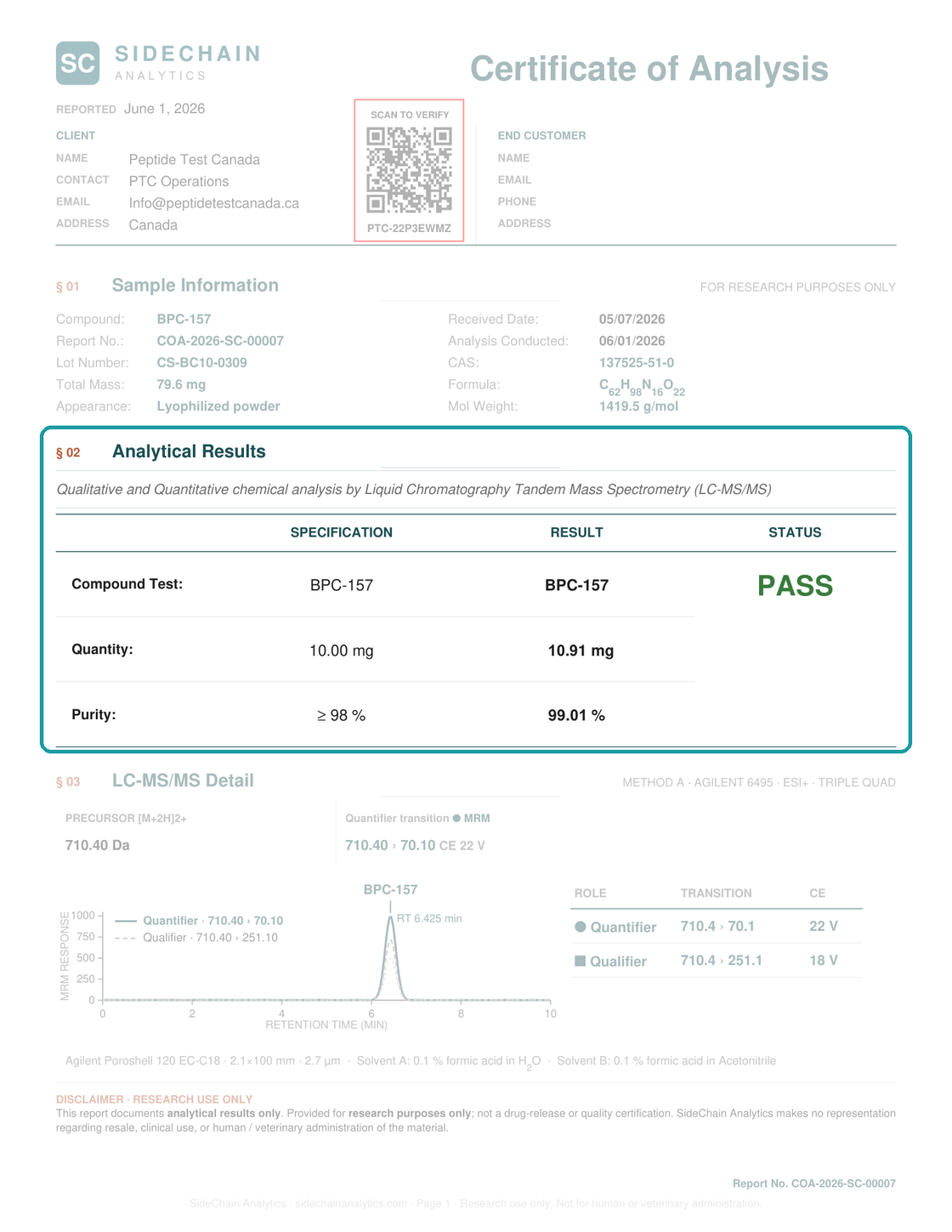
This section is the supporting evidence behind the numbers above. LC-MS/MS separates the sample and weighs its fragments to prove identity and purity at the same time.
- The chromatogram plots detector response against retention time. A single, sharp, dominant peak (here at 6.425 min) indicates a pure compound; extra peaks indicate impurities.
- The precursor mass [M+2H]²⁺ of 710.40 Da, plus the quantifier (710.4›70.1) and qualifier (710.4›251.1) transitions, confirm the molecule's identity — two matching transitions are strong proof it's the right peptide.
- The method & column line documents exactly how the test was run, which is what makes the result reproducible.
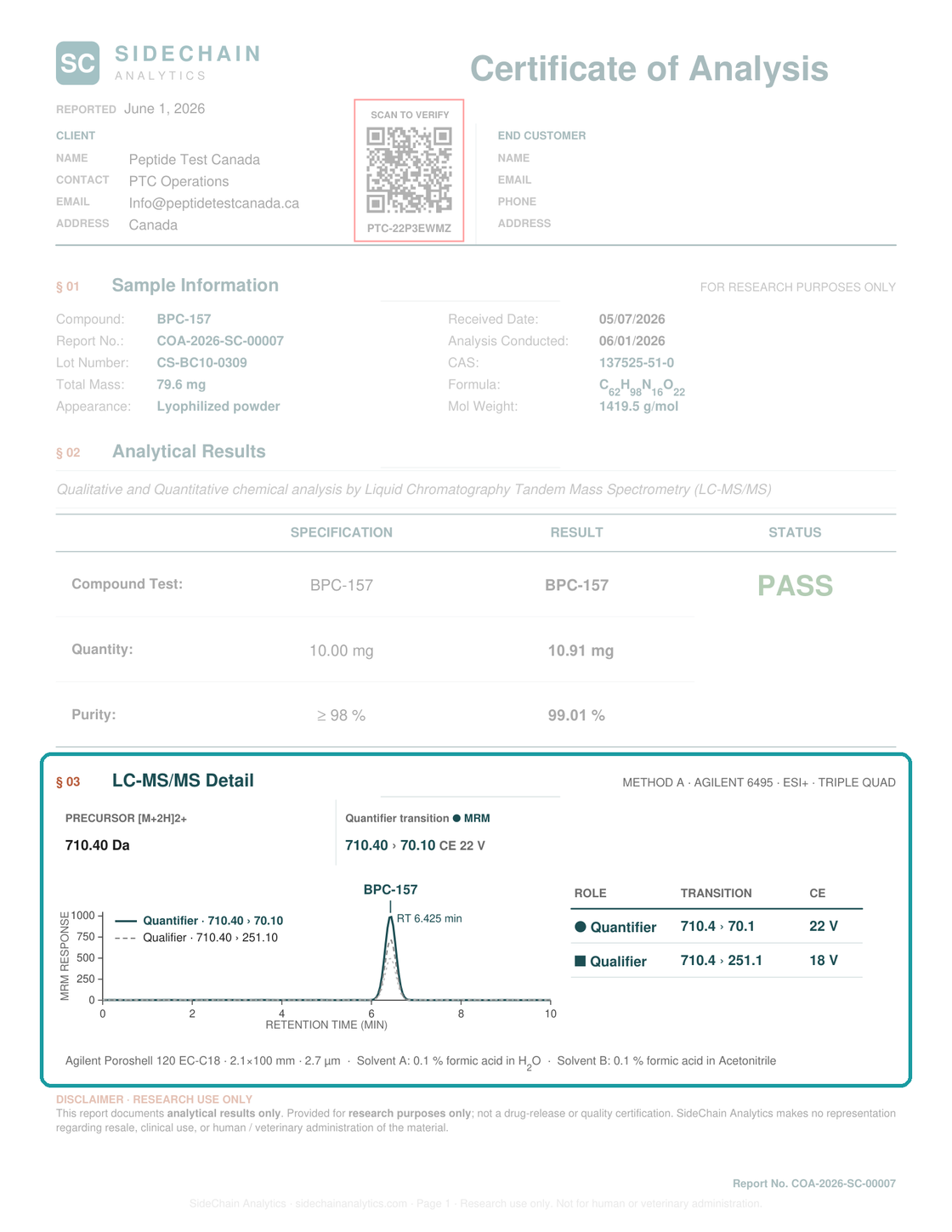
A legitimate COA states clearly that the material is for research use only and that the report documents analytical results — not a clinical or quality release. Seeing this disclaimer is expected and correct; its absence is unusual.
Your 6-point COA checklist
- An issuing laboratory and a unique report number are present.
- A working verification code resolves to Peptide Test Canada.
- The compound name, CAS number and formula match the product.
- A batch / lot number is shown and matches your vial.
- Purity is ≥ 98% with an overall PASS status.
- An LC-MS/MS chromatogram shows a single dominant peak.
If any of these are missing, ask the supplier before you buy.
Back to sections